
Hardwood Floor Refinishing in Stafford & Stafford Springs, CT: Toning Down Brazilian Cherry
Brazilian cherry is one of those hardwood species that can change dramatically over time.
It is also known for something that not every homeowner loves:
Red. Lots of red.
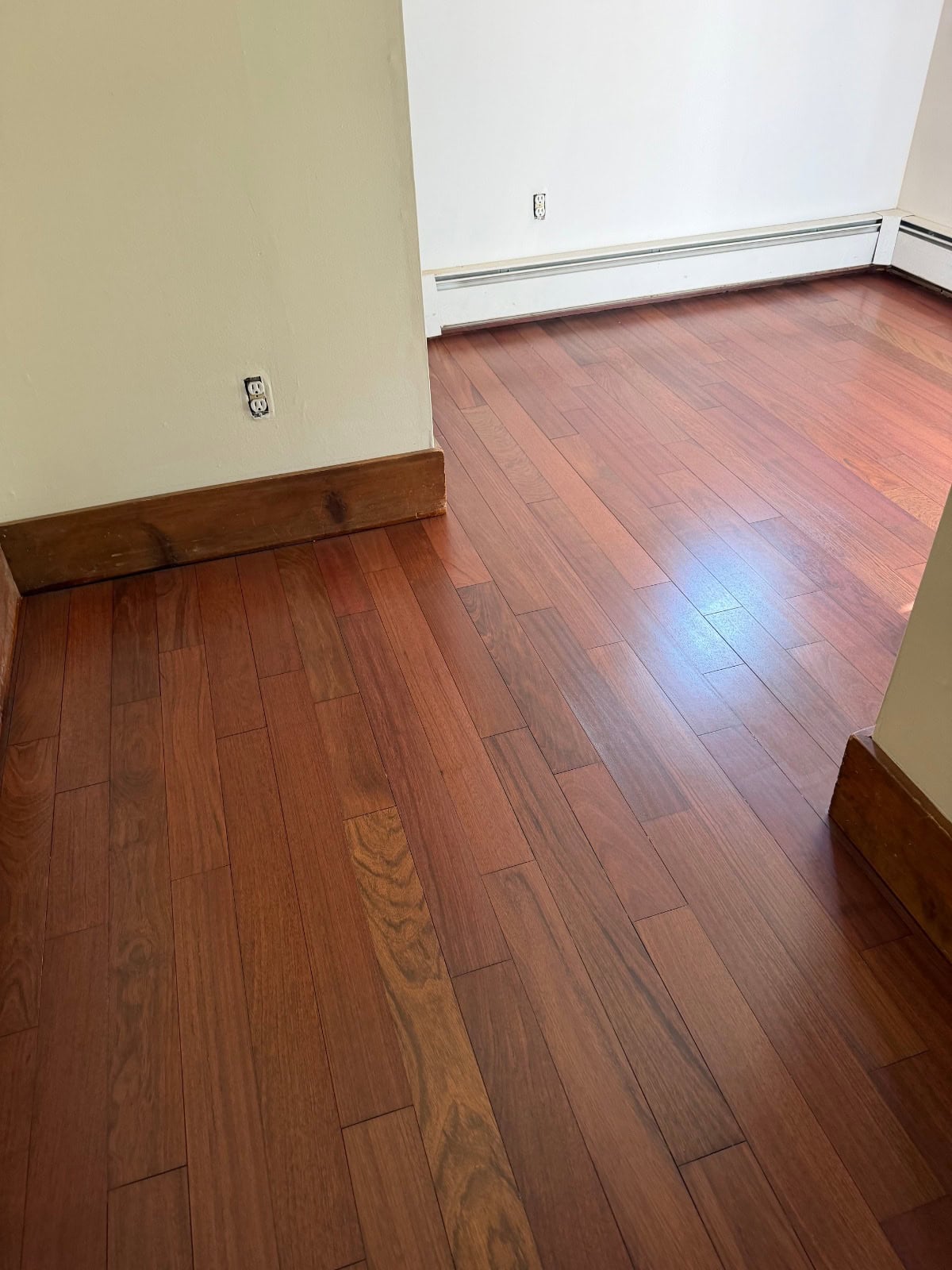
This recent hardwood floor refinishing project in Stafford and Stafford Springs, Connecticut involved a prefinished Brazilian cherry floor that had developed the deep reddish-burgundy appearance commonly associated with the species.
The homeowner wanted something different.
They didn't want to replace a beautiful hardwood floor. They simply wanted to move away from that strong burgundy color and bring the floor toward a softer combination of light browns, tans and warmer natural tones.
That made this a very interesting color project.
We professionally sanded the prefinished Brazilian cherry, created a custom stain mixture using Early American and Natural, and then used a water-based finishing system to avoid adding the additional amber warmth associated with traditional oil-based polyurethane.
The result came out beautifully.
But there's another interesting part to this story:
We're not seeing the final color yet.
Refinishing a Prefinished Brazilian Cherry Floor
Prefinished hardwood presents its own challenges.
The original factory-applied coatings can be extremely durable, and removing them requires proper sanding techniques and equipment.
Once that old factory finish was removed, we were able to get back to the Brazilian cherry itself.
That's when the real color work began.
The customer wasn't looking for a very dark floor, and they weren't trying to make Brazilian cherry look like white oak.
They simply wanted to tone down the strong burgundy-red direction.
Instead of choosing a single stain straight from a color chart, we mixed Early American with Natural to introduce enough brown and warmth to move the floor toward the direction the homeowner wanted.
Working With the Red Instead of Fighting It
There's an important distinction here.
You can't change the fact that Brazilian cherry is Brazilian cherry.
The underlying wood still has its own natural color characteristics.
That's why the red can still be visible when the floor is initially completed.
Our approach was to use the custom stain mixture to introduce brown and tan tones while using a water-based finishing system that wouldn't add the same amber coloration that an oil-based finish would.
The objective wasn't to bury the grain underneath a heavy color.
We still wanted to see the hardwood.
Change the color direction—not the identity of the wood.
This Floor Will Continue to Change
One of the fascinating characteristics of Brazilian cherry is how its color develops with exposure to light and time.
So when you look at photographs immediately after refinishing, you're seeing the floor at one point in that process.
Some of the red is still coming through.
That's expected.
As this particular floor ages, we're expecting the combination of the wood, custom Early American/Natural stain and water-based finishing system to move visually toward the look the homeowner wanted—more of a teak-like combination of warm light browns and tans, rather than the strong burgundy appearance they started with.
We'll have to wait to see the complete transformation.
And that's part of working with real hardwood.
Wood isn't static. It continues to age, react to light and develop color over time.
Hardwood Floor Refinishing in Stafford & Stafford Springs, Connecticut
Stafford is one of Connecticut's larger rural towns geographically, sitting along the Massachusetts border in northern Connecticut.
Within the Town of Stafford are several historic villages and areas, with Stafford Springs serving as the principal downtown center. Stafford's planning documents identify historic village areas including Stafford Springs, West Stafford, Stafford Hollow, Staffordville, Hydeville and Orcuttville.
For local homeowners, the principal postal areas include Stafford 06075, Stafford Springs 06076 and Staffordville 06077.
Stafford itself was settled in 1719, and its early development was influenced by agriculture, iron resources and the area's famous mineral springs. Those springs eventually attracted visitors from throughout New England; even John Adams visited the area before becoming president.
Stafford Springs later developed into an important mill and manufacturing center as waterpower from the area's rivers supported textile mills and other industries. Today, much of that history remains visible around downtown Stafford Springs.
Familiar local places include Hyde Park, Stafford's historic Main Street area, the Mineral Springs and Stafford Historical Society Museum, and Stafford's surrounding lakes, forests and rural countryside. The historic Stafford Springs downtown also retains a substantial collection of nineteenth- and early-twentieth-century commercial, civic and industrial buildings.
Serving Stafford and the Surrounding Area
Our hardwood flooring work takes us throughout Stafford 06075, Stafford Springs 06076 and Staffordville 06077, as well as neighboring communities including Somers, Ellington, Tolland, Willington, Union, Ashford and Vernon.
At Patrick Daigle Hardwood Flooring, Inc., hardwood flooring is our specialty.
Our family's hardwood flooring tradition dates to 1927, and our Connecticut business began around 1972. Today, we're the fourth generation carrying on that craftsmanship.
We're proud members of the National Wood Flooring Association (NWFA) and proud to be ranked #1 in Hartford County and #1 in Connecticut by BusinessRate.
We combine generations of hands-on experience with modern dust-containment sanding equipment and professional hardwood flooring products and finishing systems.
But a project like this Stafford floor also demonstrates why understanding wood species and color matters.
Brazilian cherry isn't red oak.
It isn't white oak.
And it isn't going to react exactly like either one.
We started with a prefinished Brazilian cherry floor that had much more burgundy-red color than the homeowner wanted. We carefully sanded away the old factory finish, developed a custom mixture of Early American and Natural, and used a water-based finishing system to move the appearance toward warmer browns and tans.
Some red is still visible today.
That's part of the wood.
Now we'll let time and light do their part.
The transformation isn't completely finished when we leave the house.
Sometimes real hardwood keeps changing—and getting more interesting—long after the final coat has dried.
Patrick Daigle Hardwood Flooring, Inc.
Fourth-Generation Hardwood Flooring Craftsmanship Since 1927
NWFA Member
Ranked #1 in Hartford County and #1 in Connecticut by BusinessRate
Serving Stafford 06075, Stafford Springs 06076, Staffordville 06077, Somers, Ellington, Tolland, Willington, Union, Ashford, Vernon and surrounding Connecticut communities.