
Hardwood Floor Refinishing in Coventry, CT: Brightening the Old Pine Floors in a Historic Home
There's something special about working on hardwood floors in an older Connecticut home.
The floors aren't supposed to look brand new.
They have age. They have character. They have imperfections that tell you they've been part of that house for generations.
That's exactly what we found on a recent hardwood floor refinishing project in a historic home in Coventry, Connecticut.
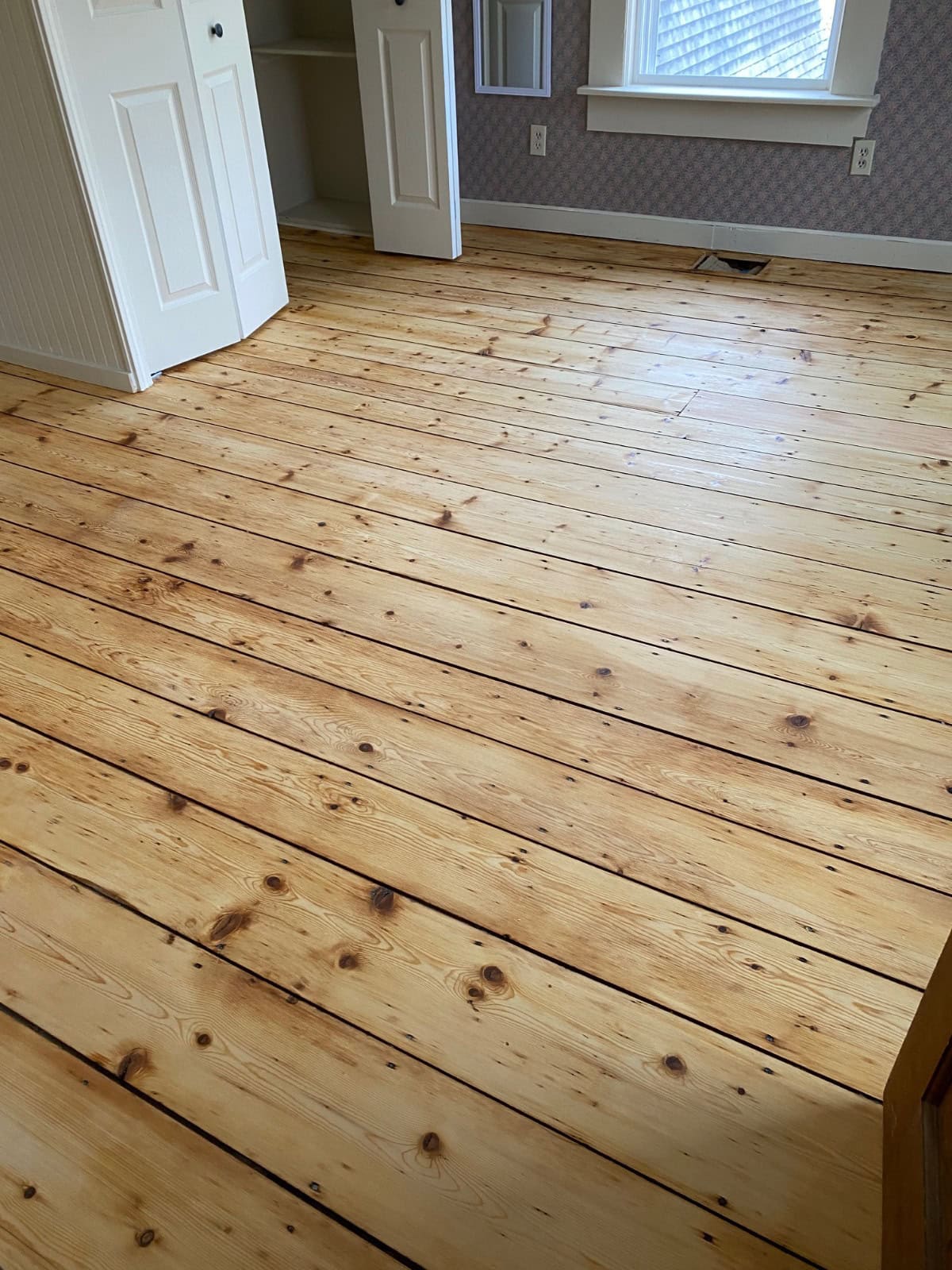
This house had beautiful old pine flooring, but years of aging and the previous finish had left the floors with a heavy orange, honey-gold, almost pumpkin-colored appearance.
The homeowners wanted something completely different.
They wanted to brighten the house while still preserving the character that made those old pine floors special.
And that's exactly what we were able to do.
Taking the Orange Out Without Taking the Character Away
One of the most dramatic changes we make in older homes isn't necessarily repairing the floor.
Sometimes it's simply getting underneath decades of old finish.
When we began professionally sanding these Coventry pine floors, that heavy orange and golden appearance started disappearing.
Underneath was something much lighter.
Old pine with beautiful natural character.
That's the part of refinishing that surprises a lot of homeowners.
They've lived with an orange or honey-colored floor for so long that they assume that's simply what their wood looks like.
Then we sand it back to raw wood.
Suddenly, they're looking at an entirely different floor.
Old Pine Requires a Different Touch
Older pine isn't the same as sanding a newer red oak floor.
Pine is considerably softer than oak, and an old pine floor may have decades—or even centuries—of wear.
There can be dents.
There can be variations in the boards.
There can be old nail holes, gaps and marks left by generations of people living in the house.
Our objective isn't to grind all of that history away.
We want to restore the floor, not erase its personality.
That's where experience becomes important.
You have to know what can be improved, what should be preserved, and how far to take the sanding without unnecessarily removing old wood.
From Pumpkin-Colored to Bright and Light
The transformation in this house was tremendous.
Before refinishing, the old finish dominated the appearance of the pine.
It was warm, dark and heavily ambered.
After sanding, the room immediately began feeling brighter.
Instead of putting that same heavy orange appearance back onto the pine, we took the floor in a much lighter direction.
The finished result allowed more of the natural variation in those old boards to become part of the room.
Same historic pine.
Completely different atmosphere.
The floors still looked appropriate for an older Coventry home—but the house felt much more current.
That's the balance we were looking for.
Historic Doesn't Have to Mean Dark
We run into this frequently in Connecticut's older homes.
People love the architecture.
They love the wide boards.
They love the old pine, oak and chestnut.
They love the craftsmanship.
What they don't necessarily love is the orange, yellow or heavily ambered finish that may have accumulated or aged over the years.
You don't always have to choose between historic character and a brighter home.
Professional sanding and the right finishing approach can sometimes give you both.
This Coventry project is a perfect example.
Working in Historic Coventry
Coventry is a particularly enjoyable town for this type of project because historic homes are such an important part of the community.
The best-known example is the Nathan Hale Homestead Museum on South Street.
Nathan Hale was born on the property in 1755, and the Georgian-style Hale family home was completed in 1776. Today, the 17-acre property adjoins roughly 1,500 acres of Nathan Hale State Forest.
Working on an old pine floor in Coventry makes you appreciate how much traditional building material survives in this part of Connecticut.
These weren't disposable houses.
And their hardwood and softwood floors weren't intended to be disposable either.
Coventry Lake and Patriots Park
Another landmark almost everyone in the area knows is Coventry Lake, also called Lake Wangumbaug.
Along the lake is Patriots Park, one of the town's major recreational areas, with swimming, waterfront recreation and community events.
The lake and the surrounding historic village are a big part of Coventry's identity. Connecticut's tourism office describes the town as a mix of woods, farmland, historic sites and recreation, including Coventry Lake, Patriots Park, Nathan Hale State Forest and the historic village.
The Strong-Porter House and Old Coventry
There's also the Strong-Porter House Museum on South Street, another reminder of just how deep Coventry's history runs.
And the town's historic landscape extends beyond individual houses.
There are old farms, stone walls, barns and country roads throughout Coventry. There's the historic South Coventry village, the Nathan Hale Monument and the old mill areas that developed around the community.
For people interested in something a little different, Coventry even has a history of glassmaking, preserved today through The Museum of Connecticut Glass, Inc..
It's a town where history isn't confined to one museum.
It's in the houses.
It's in the landscape.
And sometimes it's right underneath your feet.
Four Generations Working on Connecticut Hardwood Floors
At Patrick Daigle Hardwood Flooring, Inc., our family's hardwood flooring tradition dates back to 1927.
The Connecticut business was established by the previous generation around 1972, and today we represent the fourth generation of our family's hardwood flooring tradition.
We're proud members of the National Wood Flooring Association (NWFA) and combine generations of hands-on experience with modern dust-containment sanding equipment and today's professional finishing systems.
We're also proud to be ranked #1 in Hartford County by BusinessRate, along with our recognition as #1 in Connecticut.
We've worked throughout Coventry, Mansfield, Columbia, Andover, Bolton, Vernon, Manchester, Tolland, Hebron and the surrounding communities for decades.
And old floors like this Coventry pine project are some of the most rewarding ones we get to work on.
Have Old Pine Floors in Coventry, CT?
If you own an older or historic home and your pine floors have become dark, orange, yellow or honey-colored, don't automatically assume that's what the wood has to look like.
Have the floors professionally evaluated.
There may be an entirely different appearance hiding underneath decades of old finish.
That's what happened with this historic Coventry home.
We started with old pine floors covered by a heavy orange, honey-gold, pumpkin-colored appearance.
We carefully sanded away the old finish and brought the natural character of the pine back.
Then we took the floors in a much lighter direction.
The result transformed the rooms.
We didn't make the old pine look new.
We made the old pine beautiful again.
And in a historic Coventry home, we think that's exactly the way it should be.
Patrick Daigle Hardwood Flooring, Inc.
Fourth-Generation Hardwood Flooring Craftsmanship Since 1927
NWFA Member
Ranked #1 in Hartford County by BusinessRate
Serving Coventry, Mansfield, Columbia, Andover, Bolton, Vernon, Manchester, Tolland, Hebron and communities throughout Connecticut