

Hardwood Floor Repair & Refinishing in Columbia, CT: Making a Removed Wall Disappear
Sometimes a hardwood floor project isn't just about sanding and refinishing.
Sometimes we have to rebuild part of the floor before we can make it beautiful again.
That was the situation on a recent project near the Columbia-Lebanon town line in Columbia, Connecticut.
The homeowners had beautiful red oak hardwood flooring, but a wall had been removed in the middle of the living space.
Once that wall was gone, it left a substantial opening right through the hardwood floor.
You couldn't simply sand over something like this.
We had to make the missing section become part of the floor again.
After repairing and integrating new red oak into the existing flooring, we sanded everything together and finished the floor with Bona NordicSeal followed by three coats of Bona Traffic.
The transformation was beautiful.
Instead of seeing where a wall once divided the room, you now see one continuous, light and updated red oak floor.
Taking Down a Wall Can Create a Hardwood Flooring Problem
Opening up an older home can dramatically change the way it feels.
Walls come down.
Rooms become larger.
Natural light travels farther through the house.
But there's something homeowners don't always think about until that wall is gone:
What's underneath it?
If hardwood was installed on both sides of a wall, there may be no flooring where the wall and framing once stood.
That's exactly what we encountered on this Columbia project.
There was a large section missing directly in the middle of the existing red oak flooring.
That's where hardwood floor repair becomes much more than replacing one damaged board.
Making the Repair Blend Into the Existing Red Oak
The goal wasn't simply to fill the opening with wood.
We wanted the repair to become part of the existing floor.
That means paying attention to the species, dimensions, direction of the flooring and how the new boards integrate with the original hardwood.
A repair placed directly in the middle of a room is particularly unforgiving.
Everyone walks past it.
Light travels across it.
And if the repair isn't handled correctly, your eye can immediately find the place where the wall used to be.
After completing the repair, we sanded the new and existing red oak together.
That's when everything began coming together.
The old room divisions disappeared, and the hardwood started reading as one continuous floor again.
A Lighter Look With Bona NordicSeal
The homeowners also wanted to brighten the house and give the red oak a more updated appearance.
For this project we used Bona NordicSeal, followed by three coats of Bona Traffic.
NordicSeal gave us a lighter direction while still allowing the natural character and grain of the red oak to remain visible.
The Bona Traffic finishing system then provided the durable waterborne protection the floor needed.
It was a great combination for this particular house.
The lighter floor complemented the newly opened space.
Instead of removing a wall and then putting a heavy, dark or strongly amber finish back onto the hardwood, the lighter finishing system helped reinforce what the renovation was trying to accomplish.
More open. More light. More connected.
The Best Repair Is the One You Stop Looking At
That's always one of our goals with hardwood floor repair.
We don't want somebody walking into the room and immediately asking:
“Where did you repair the floor?”
We'd rather have them look at the entire hardwood floor.
This project required a substantial repair directly where the old wall had been.
But after the repair, sanding, NordicSeal and Traffic finish, the focus wasn't on the patched area anymore.
It was on the finished floor.
That's when you know the repair worked.
Near the Columbia-Lebanon Line
This project was near the Columbia-Lebanon line, which is interesting because the two towns share much more than a modern boundary.
Columbia was once actually part of Lebanon.
The area that eventually became Columbia was known historically as Lebanon's North Parish, the Second Ecclesiastical Society and Lebanon Crank.
Columbia separated from Lebanon and became its own town in 1804.
So when we're working near the Columbia-Lebanon line today, we're working in two communities whose histories have been connected for centuries.
Columbia Lake and the Town Green
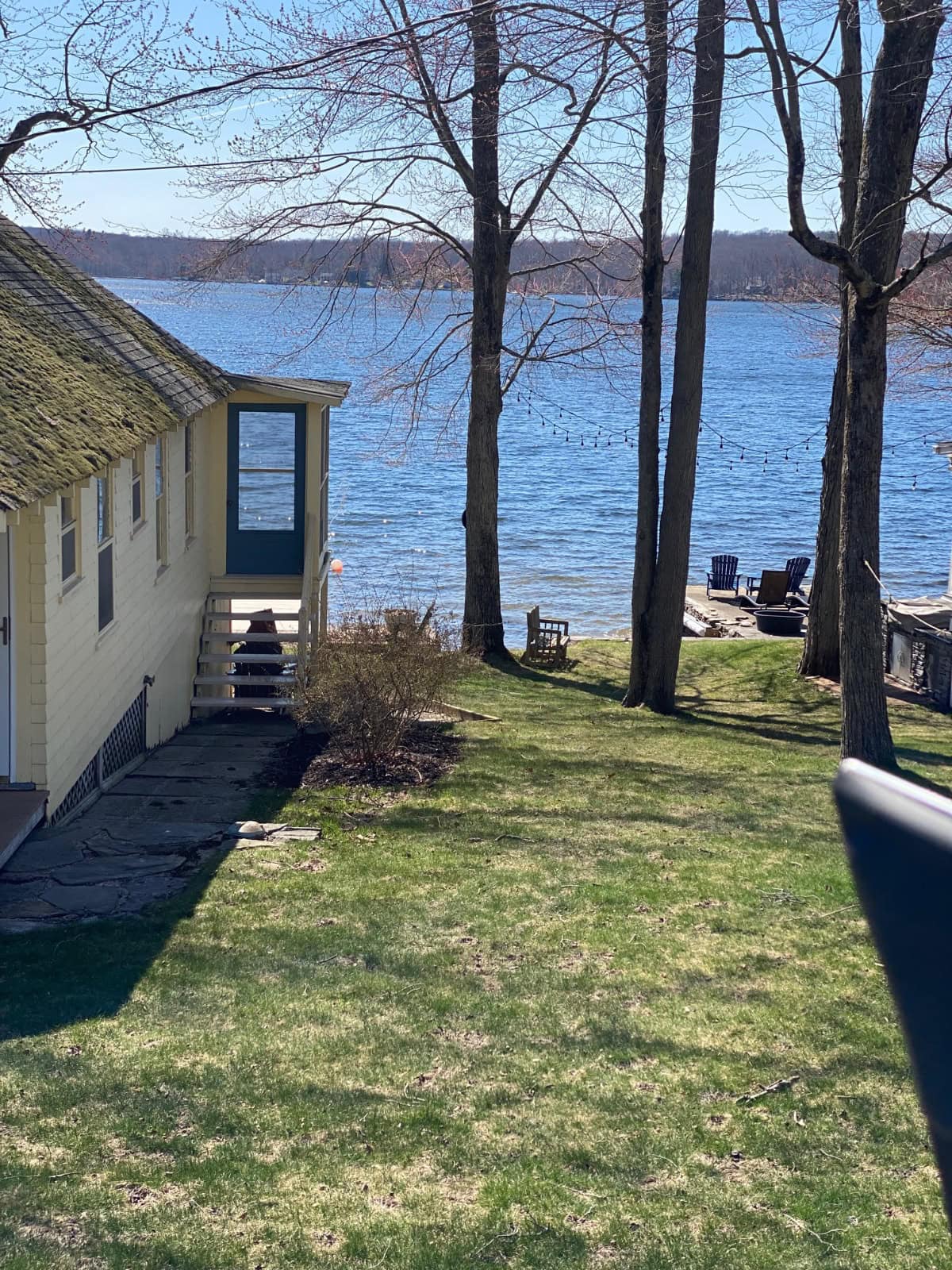
One of Columbia's best-known landmarks is Columbia Lake, a roughly 281-acre lake in the heart of town.
Today it's one of Columbia's defining recreational areas, with swimming, kayaking, sailing, boating and fishing enjoyed by local residents.
There's also the historic Columbia Town Green, at the intersection of Routes 87 and 66.
Around the Green are several important community and historic sites, including Yeomans Hall, the Saxton B. Little Library, Chapel on the Green and Moor's Charity School, along with memorials and other town buildings.
That area helps preserve the traditional rural New England character that still makes Columbia distinctive.
A Town With Revolutionary War History
Columbia also has a fascinating connection to the Revolutionary period.
Long before Columbia became a separate town, the old Lebanon Crank area served as a colonial crossroads.
Historic accounts from the town describe George Washington's Continental troops and General Rochambeau's French forces traveling through this area during the Revolutionary War period.
Just across the town line, Lebanon has its famous mile-long Green and its cluster of Revolutionary-era sites associated with Governor Jonathan Trumbull and Connecticut's role in supporting the American Revolution.
So there's quite a bit of history packed into this quiet part of eastern Connecticut.
Trails, Woods and Water
For people who know Columbia for outdoor recreation, there's plenty beyond the lake.
The Hop River State Park Trail travels along Columbia's northern side and follows the route of a former railroad. It connects this part of eastern Connecticut with Andover, Bolton, Vernon and Manchester.
Columbia also has the Air Line State Park Trail along its southeastern side.
There's Mono Pond, Szegda Farm, Utley Hill Preserve, and miles of smaller trails and protected land throughout town.
It's one of the things we enjoy about working in Columbia.
You can be only a short drive from Manchester and Hartford County, but the landscape quickly changes to woods, stone walls, fields, lakes and older Connecticut homes.
Working Throughout Columbia, Lebanon and Eastern Connecticut
At Patrick Daigle Hardwood Flooring, Inc., we've worked throughout this entire part of Connecticut for decades.
Our projects regularly take us through Columbia, Lebanon, Hebron, Amston, Andover, Bolton, Coventry, Mansfield, Willimantic and Manchester.
We've worked on older homes, newer construction, wide-plank flooring, traditional red and white oak, water-damaged floors, pet-damaged floors, stairs and complicated repairs like this one.
And that's where generations of experience become particularly important.
Sanding a straightforward floor is one thing.
Figuring out how to rebuild the middle of an existing hardwood floor after a wall has been removed is another.
Four Generations of Hardwood Flooring Experience
Our family's hardwood flooring tradition dates back to 1927.
Today, Patrick Daigle Hardwood Flooring, Inc. represents the fourth generation of that tradition.
We're proud members of the National Wood Flooring Association (NWFA) and combine generations of hands-on flooring experience with modern dust-containment sanding equipment and today's professional finishing systems.
We're also proud to be ranked #1 in Hartford County by BusinessRate, along with our recognition as #1 in Connecticut.
For us, projects like this Columbia floor show what hardwood floor restoration is really about.
It's not always just changing the color.
Sometimes it's solving a construction problem first.
Did You Remove a Wall Between Two Hardwood Floors?
If you're remodeling a home in Columbia, Lebanon or the surrounding area and removing a wall between rooms with existing hardwood flooring, don't assume the only solution is replacing the entire floor.
Depending on the existing flooring and layout, it may be possible to professionally integrate new hardwood into the opening and refinish everything together.
That's exactly what we did on this Columbia project.
A wall came out.
A large opening was left directly in the middle of the red oak floor.
We repaired the missing hardwood, sanded the new and existing flooring together, applied Bona NordicSeal and finished it with three coats of Bona Traffic.
Now, instead of seeing where the wall used to be, you see one beautiful continuous hardwood floor.
The wall disappeared.
And we made the flooring look like it belonged together all along.
Patrick Daigle Hardwood Flooring, Inc.
Fourth-Generation Hardwood Flooring Craftsmanship Since 1927
NWFA Member
Ranked #1 in Hartford County by BusinessRate
Serving Columbia, Lebanon, Hebron, Amston, Andover, Bolton, Coventry, Mansfield, Manchester and communities throughout Connecticut