

Hardwood Floor Repair in West Hartford, CT: Making Stain Damage Practically Disappear
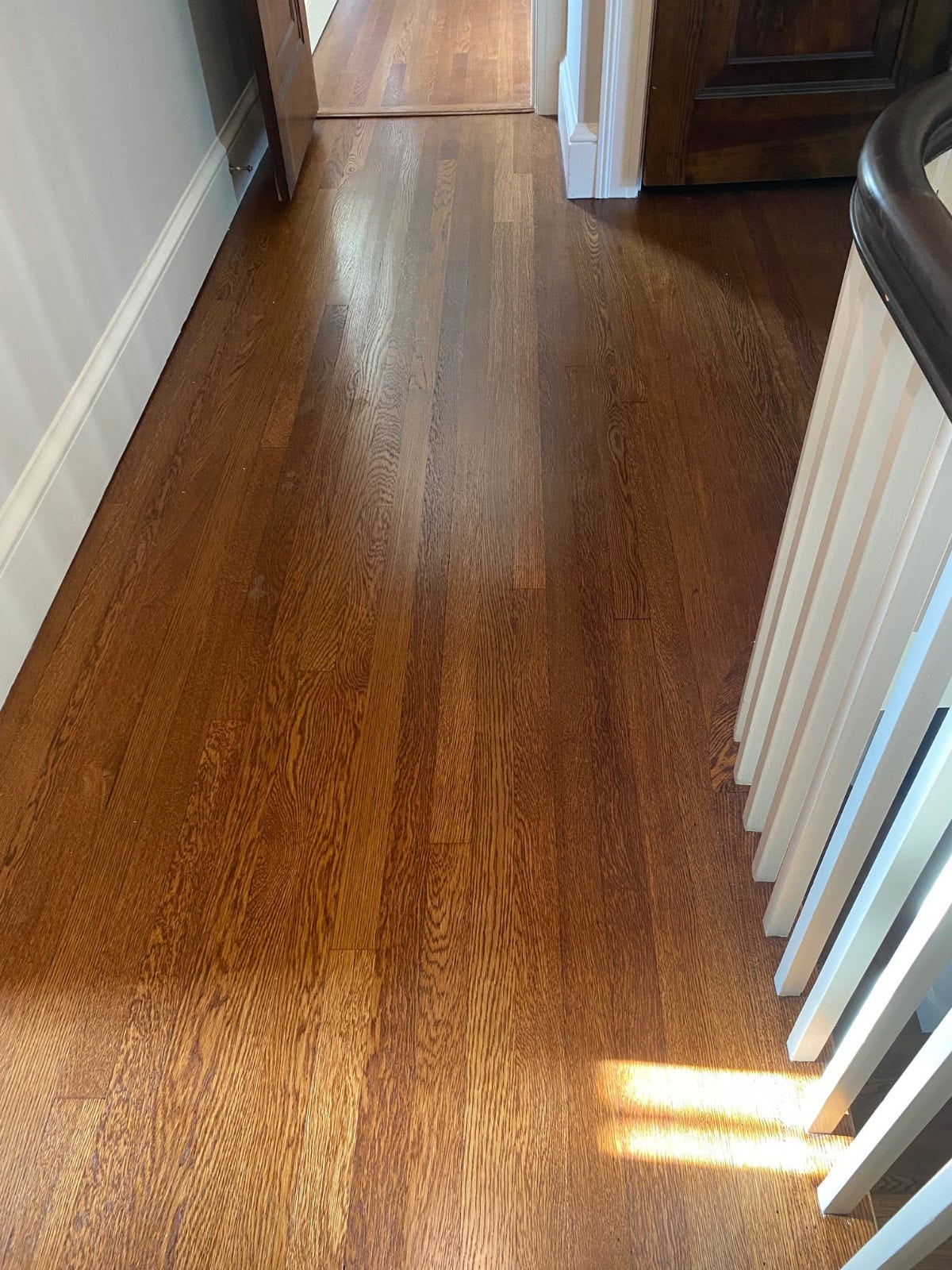
Sometimes the most difficult hardwood flooring jobs aren't the biggest ones.
They're the smallest.
A few inches of damage on a stained hardwood floor can sometimes be more challenging to repair than sanding and refinishing an entire room.
That's exactly what happened recently at a beautiful historic home in West Hartford, Connecticut.
We had completely sanded, stained and refinished these hardwood floors only about two months earlier. The transformation had brought the old floors back to life and given them a rich, traditional appearance that worked beautifully with the character of the house.
Then an accident happened.
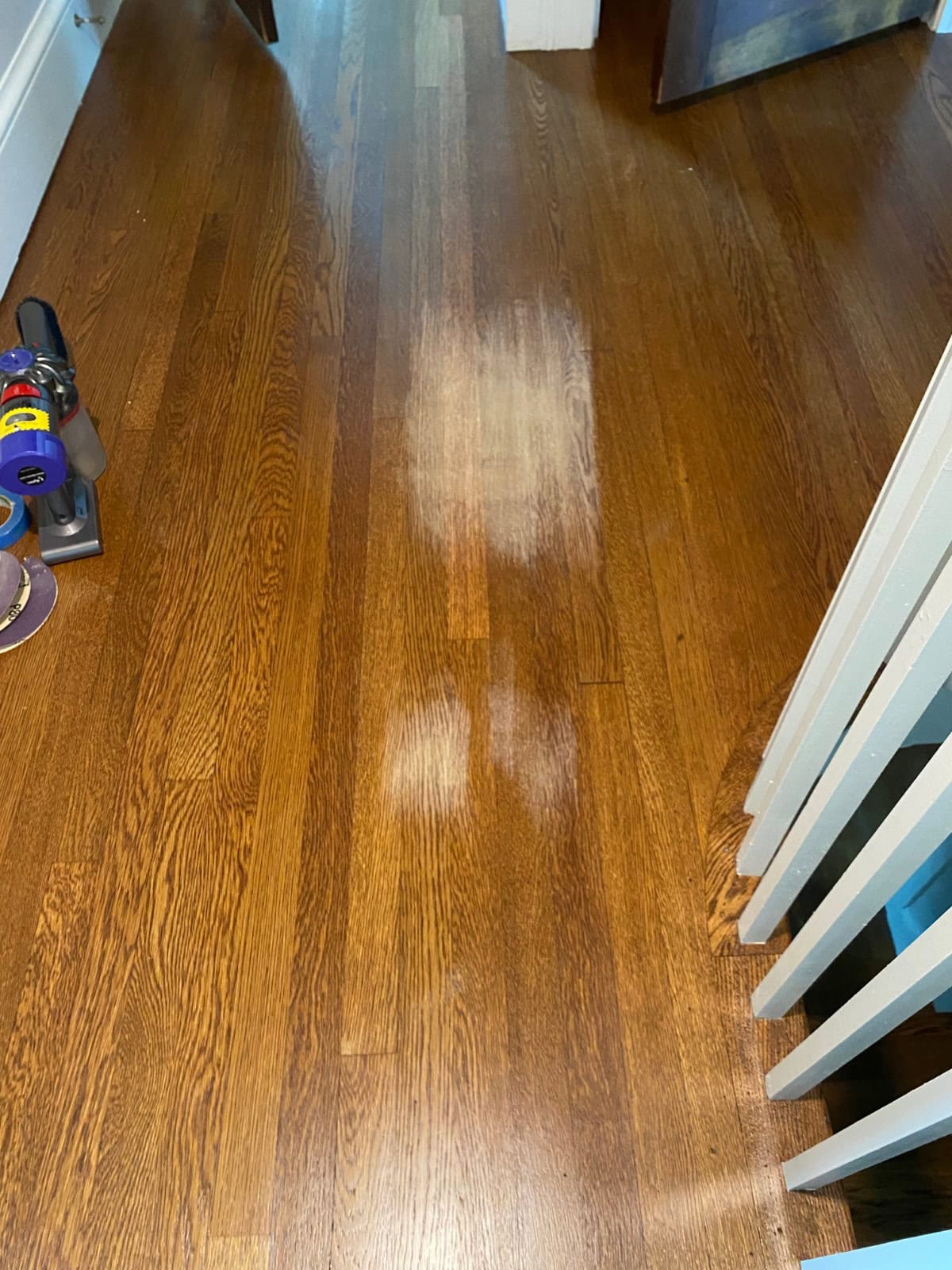
While painters were working in the home, thinner was accidentally spilled onto the hardwood floor, damaging the finish and stain underneath it.
Now we had a challenge:
Could we repair one damaged area without refinishing the entire floor?
Why Repairing a Stained Hardwood Floor Is So Difficult
This is something homeowners don't always realize.
A natural hardwood floor can often be more forgiving when it comes to localized repairs.
A stained floor is different.
When hardwood is originally sanded and stained, the color you see isn't simply paint sitting on top of the wood. The stain interacts with the wood itself.
Wood species, grain, sanding sequence, stain color, application technique, absorption, drying time, sealer and finish all contribute to the final appearance.
Now imagine trying to reproduce all of that in one small damaged area while making it blend into a floor that's already finished.
That's where it gets difficult.
Fortunately, We Knew Exactly What Was on This Floor
There was one major advantage on this West Hartford repair:
We were the original flooring contractor.
Only two months earlier, we had sanded and refinished the entire floor ourselves.
We knew how the floor had been prepared.
We knew the stain system.
We knew the finishing system.
And we knew what the floor looked like throughout the original process.
The floor had been given a custom traditional color using DuraSeal stain in the Early American/American Brown color range, followed by an oil-based polyurethane finishing system.
Having that information gave us a much better starting point for attempting the repair.
That's why, whenever possible, we recommend contacting the contractor who originally refinished your hardwood floors if accidental damage occurs.
They know what they put down and how they put it down.
That can make an enormous difference.
Step One: Carefully Removing the Damage
If you look at the first photograph from this West Hartford project, you can see the area damaged by the thinner.
We couldn't simply put more stain over it.
First, the damaged area had to be addressed.
We lightly and carefully sanded the affected portion, removing the damaged material while trying not to unnecessarily enlarge the repair.
This is where restraint matters.
We're not trying to turn a small repair into a large refinishing project.
We're trying to create a properly prepared area that gives us the best opportunity to rebuild the color and finish.
Then Comes the Hard Part: Matching the Stain
Once the damaged area was prepared, we began reintroducing the stain.
But we didn't simply stop exactly where the visible damage ended.
That can create a noticeable line between the repaired area and the surrounding floor.
Instead, we carefully extended and feathered the color beyond the immediate repair, working it into the surrounding area to help soften the transition.
This is where hardwood floor repair becomes part technical process and part craftsmanship.
You're constantly looking at color.
You're looking at grain.
You're watching how the wood accepts the stain.
And you're trying to make your repair disappear into something that was finished months earlier.
Look at the Final Picture
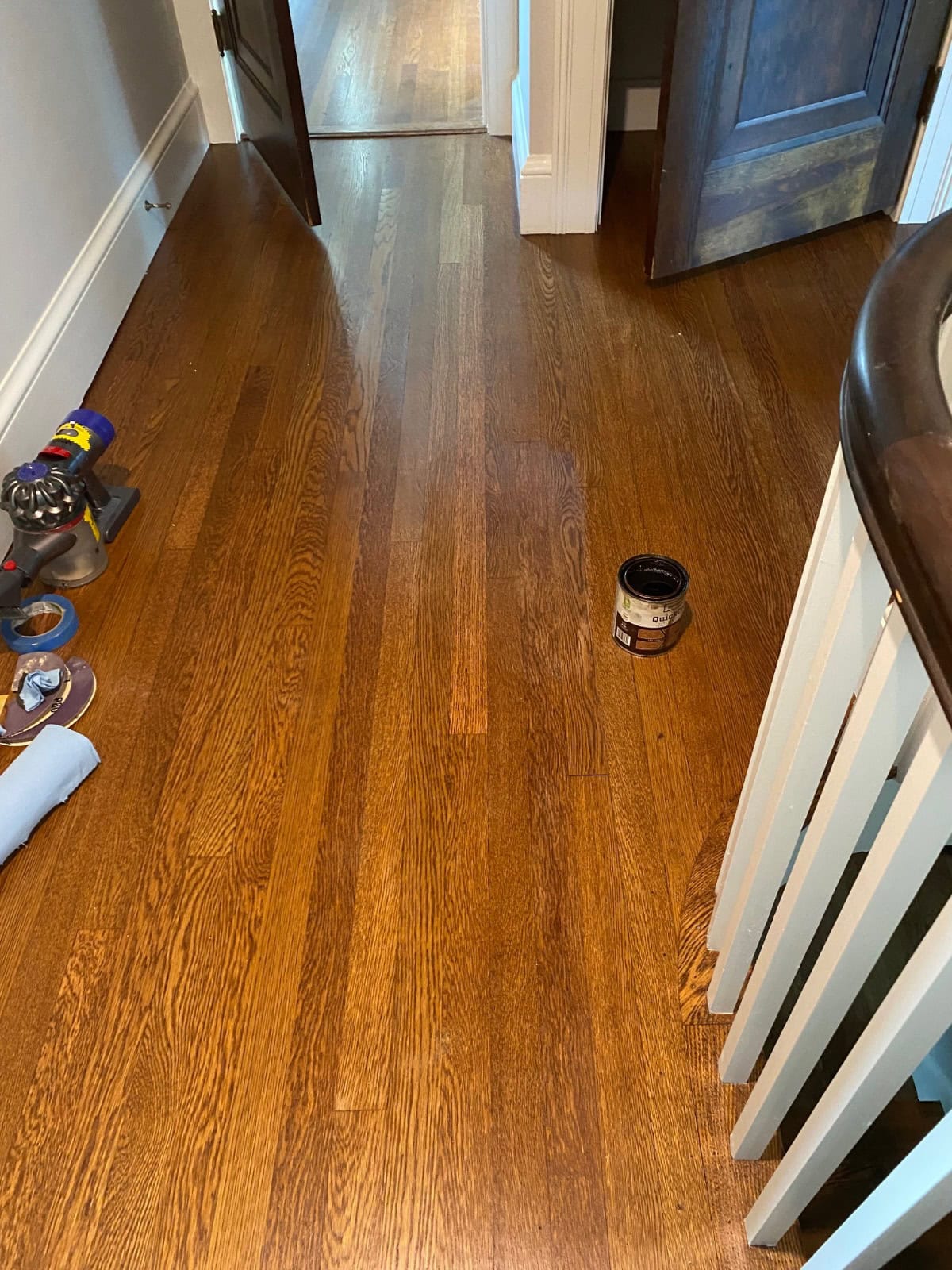
This is one of those projects where the photographs tell the story.
Look at the damage in the first picture.
Then look at the completed repair.
It's practically unnoticeable.
We were extremely pleased with the outcome.
But here's something important:
We also got lucky.
We don't tell homeowners that every stained hardwood floor can be spot-repaired this successfully.
Sometimes a localized stain repair blends beautifully.
Sometimes the surrounding floor, wood grain, color, age of the finish or extent of the damage makes a perfect blend impossible.
In those situations, a larger area—or sometimes an entire room—may need to be refinished to achieve an acceptable result.
Being experienced means knowing what's possible.
It also means being honest when something can't be guaranteed.
Natural Floors Are Usually More Forgiving
Generally, a natural-colored hardwood floor is easier to repair than a stained floor.
Why?
Because with a stained floor, we're trying to reproduce another layer of color before rebuilding the finish.
Even if we have the exact same can of stain, the repaired wood may accept that stain differently depending upon how it was sanded and the characteristics of the individual boards.
That's why the sanding process is directly connected to the color.
The National Wood Flooring Association — NWFA — provides professional guidance on sanding, finishing and repair procedures, and those fundamentals become especially important when attempting a localized repair.
The repair isn't simply about having the right color written on the can.
It's about reproducing the process that created the color.
Why Calling the Original Flooring Contractor Matters
If another contractor accidentally damages your recently refinished hardwood floor, resist the temptation to immediately have someone else try to touch it up.
Call the flooring contractor who did the original work first.
They may know:
- Exactly how the floor was sanded.
- The stain manufacturer and color combination.
- Whether colors were mixed or customized.
- What sealer was used.
- What finish was applied.
- The sheen of the finish.
- How many coats were applied.
- How the products behaved on your particular hardwood.
Those details can be extremely valuable when you're trying to make a repair disappear.
On this West Hartford project, we knew the history of the floor because we created the finished appearance in the first place.
That gave us our best opportunity to save it.
Restoring Hardwood in West Hartford's Older Homes
Projects like this are one of the reasons we enjoy working in West Hartford, Connecticut.
The community has many beautiful older homes where genuine hardwood is part of the architecture and character of the property.
Only a couple of months before this accident, these floors had looked tired and worn.
We sanded them back, developed a custom traditional stain color and protected them with oil-based polyurethane.
The refinished hardwood helped bring the character of this historic home back to life.
So when the painter's accident happened, we didn't want to lose all that work because of one damaged area.
Fortunately, we didn't have to.
Four Generations of Hardwood Flooring Experience
At Patrick Daigle Hardwood Flooring, Inc., our family's hardwood flooring tradition dates back to 1927.
We're proud members of the National Wood Flooring Association (NWFA) and proud to be ranked #1 in Hartford County by BusinessRate, along with our recognition as #1 in Connecticut.
We provide hardwood floor sanding, refinishing, installation and repair throughout West Hartford, Hartford, Farmington, Avon, Glastonbury, Manchester and communities across Hartford County and Connecticut.
But projects like this remind us that experience isn't only about handling large projects.
Sometimes experience means knowing how little to do.
How lightly to sand.
How far to extend the stain.
How to feather a repair.
And perhaps most importantly, knowing when to tell a homeowner that a localized repair may—or may not—work.
Have Damage to a Stained Hardwood Floor in West Hartford?
Paint thinner, water, scratches, construction damage and other accidents don't necessarily mean an entire hardwood floor has to be refinished.
Sometimes a localized repair is possible.
But stained floors can be particularly challenging, and we recommend having the damage evaluated before anyone begins experimenting with stain or finish.
If the floor was recently refinished, contact your original hardwood flooring contractor first whenever possible.
They know the products.
They know the process.
And they know your floor.
For this historic West Hartford hardwood floor repair, everything came together.
The damage was carefully sanded.
The stain was recreated and blended into the surrounding floor.
The finish was restored.
And when we stepped back and looked at the final result?
You could hardly tell anything had ever happened.
That's exactly the way a successful hardwood floor repair should end.
Patrick Daigle Hardwood Flooring, Inc.
Fourth-Generation Hardwood Flooring Craftsmanship Since 1927
NWFA Member
Ranked #1 in Hartford County by BusinessRate
Serving West Hartford, Hartford County and communities throughout Connecticut