
Hardwood Floor Refinishing in Newington, CT: Restoring a Unique Red & White Oak Pattern
Every once in a while, we come across a hardwood floor that is completely different from what we normally see.
This recent hardwood floor refinishing project in Newington, Connecticut 06111 was one of those floors.
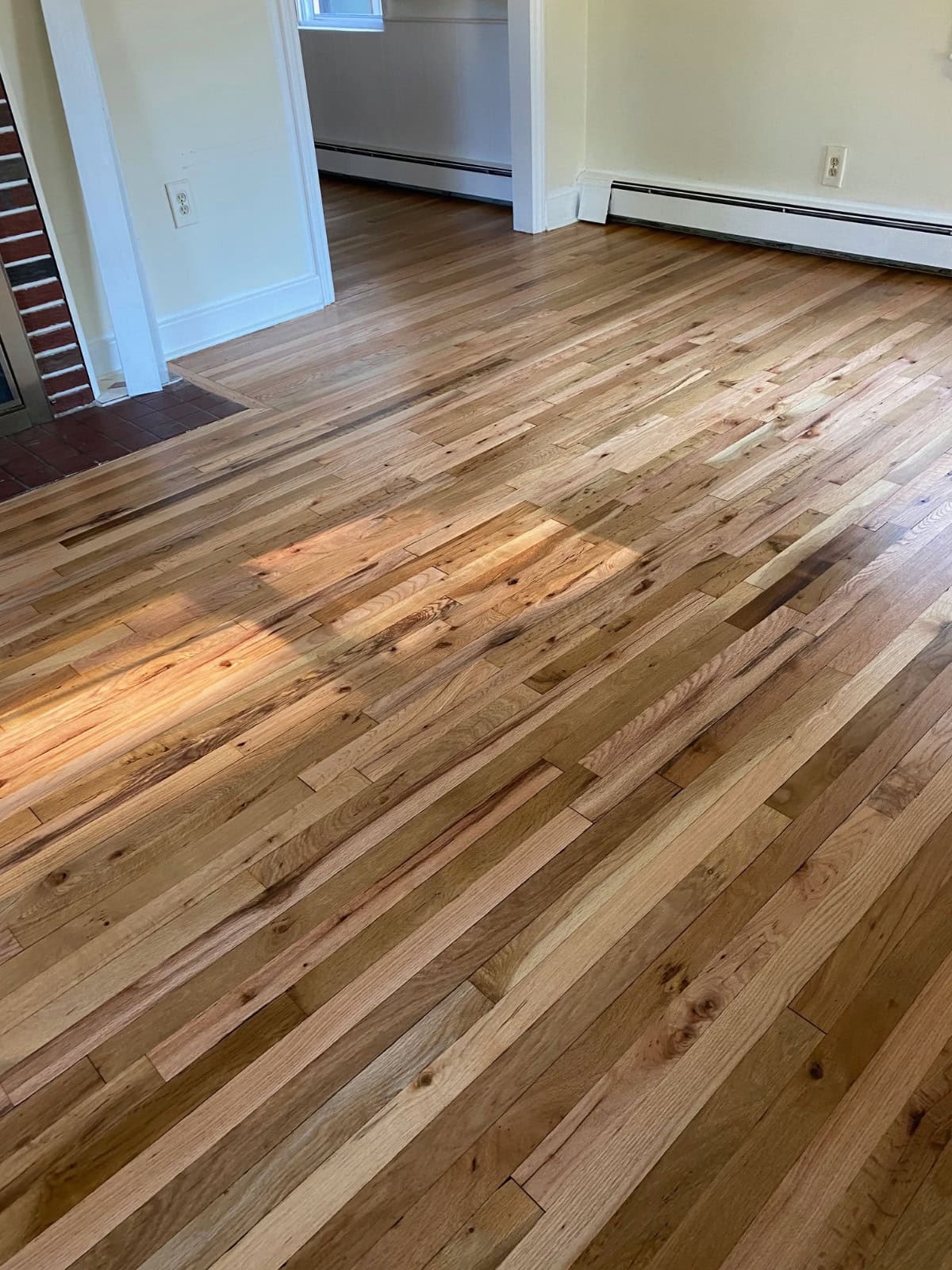
Instead of a conventional floor made from a single species of hardwood, this floor had an interesting pattern incorporating both red oak and white oak.
That mixture gave the floor a character all its own—and it also made the refinishing process more challenging.
Our goal wasn't to make the two woods look identical. It was to properly sand the entire floor, preserve the interesting pattern and choose a finishing system that would bring out the warmth and natural differences between the red and white oak.
After sanding the floor back to raw wood, we applied a commercial sealer followed by two coats of oil-based polyurethane.
The finished result was beautiful.
Two different oaks. One interesting pattern. And a hardwood floor worth preserving.
Red Oak and White Oak in the Same Floor
Red oak and white oak are two of the most common hardwood flooring species we work with in Connecticut.
But seeing both species incorporated into the same patterned floor is much less common.
Once we began removing the old finish, the differences between the woods became much easier to appreciate. Red oak and white oak have their own grain characteristics and natural color variations, and those differences were part of what made this floor special.
Patterned hardwood also requires additional attention during sanding.
Instead of simply working with long rows of flooring running in one direction, the pattern can introduce changes in grain direction. Add two different species of oak to the equation, and it becomes the kind of project where experience really matters.
Professional sanding isn't simply about getting the old finish off.
We want to bring the floor back to clean, properly prepared raw wood while maintaining a smooth surface and preserving as much of the original hardwood as possible.
As the sanding progressed, the original craftsmanship of this Newington floor began showing again.
The pattern had been there all along. It just needed to be uncovered.
Choosing a Traditional Oil-Based Finish
Once the sanding was complete, we decided to stay with a warmer, more traditional finishing direction.
We applied a commercial sealer followed by two coats of oil-based polyurethane.
Oil-based polyurethane naturally adds warmth and depth to hardwood, and it worked particularly well with the mixture of red oak and white oak.
Rather than trying to hide the differences between the two species, the finishing system allowed the grain, color variation and pattern to remain visible.
That's an important part of what we do.
Not every floor should be made lighter.
Not every red oak floor needs to have its red tones reduced.
And not every older floor should be made to look like something installed yesterday.
Sometimes the character of the existing hardwood tells you which direction to go.
On this Newington floor, warmth and character were part of the beauty.
Hardwood Flooring in Newington, Connecticut
We've worked throughout Central Connecticut for generations, and Newington has always been an important part of that area.
Newington's primary ZIP code is 06111, and the town has an interesting mixture of established neighborhoods, older homes and newer residential areas.
Newington was originally part of Wethersfield before becoming an independent town in 1871. Today, familiar areas around Newington Center, Main Street, Willard Avenue and the Berlin Turnpike give the community a mixture of historic Connecticut character and modern development.
One of the town's best-known gathering places is Mill Pond Park, while the historic Kellogg-Eddy House on Willard Avenue preserves another piece of Newington's history.
The National Iwo Jima Memorial is another recognizable landmark in the Newington area.
We also regularly work in surrounding communities including Wethersfield, West Hartford, New Britain, Berlin, Rocky Hill, Farmington and Hartford.
Four Generations of Hardwood Flooring Experience
At Patrick Daigle Hardwood Flooring, Inc., hardwood flooring is our specialty.
Our family's hardwood flooring tradition dates to 1927, and our Connecticut business began around 1972. Today, we're the fourth generation carrying on that craftsmanship.
We're proud members of the National Wood Flooring Association (NWFA) and proud to be ranked #1 in Hartford County and #1 in Connecticut by BusinessRate.
We combine generations of hands-on hardwood flooring knowledge with modern dust-containment sanding equipment, professional sanding techniques and today's high-quality finishing systems.
But a project like this demonstrates something that can't simply come from a product label or a sanding machine.
You have to understand the floor in front of you.
This Newington floor had an unusual pattern, two different oak species and its own character. Instead of trying to make it look like every other hardwood floor, we worked with what was already there.
After professional sanding, a commercial sealer and two coats of oil-based polyurethane, the red oak, white oak and original pattern became the feature of the floor again.
We didn't try to make two different woods look the same.
We let the craftsmanship that brought them together become part of the floor again.
Patrick Daigle Hardwood Flooring, Inc.
Fourth-Generation Hardwood Flooring Craftsmanship Since 1927
NWFA Member
Ranked #1 in Hartford County and #1 in Connecticut by BusinessRate
Serving Newington, CT 06111, Wethersfield, West Hartford, New Britain, Berlin, Rocky Hill, Farmington, Hartford and surrounding Connecticut communities.