Hardwood Floor Repair in Storrs & Mansfield, CT: Creating a Transition After a Wall Was Removed
Removing a wall can completely change the way a house feels.
But once the wall is gone, there's often another problem waiting underneath it:
What do you do with the hardwood floor where the wall used to be?
That was the situation on this recent hardwood floor repair project in Storrs and Mansfield, Connecticut.
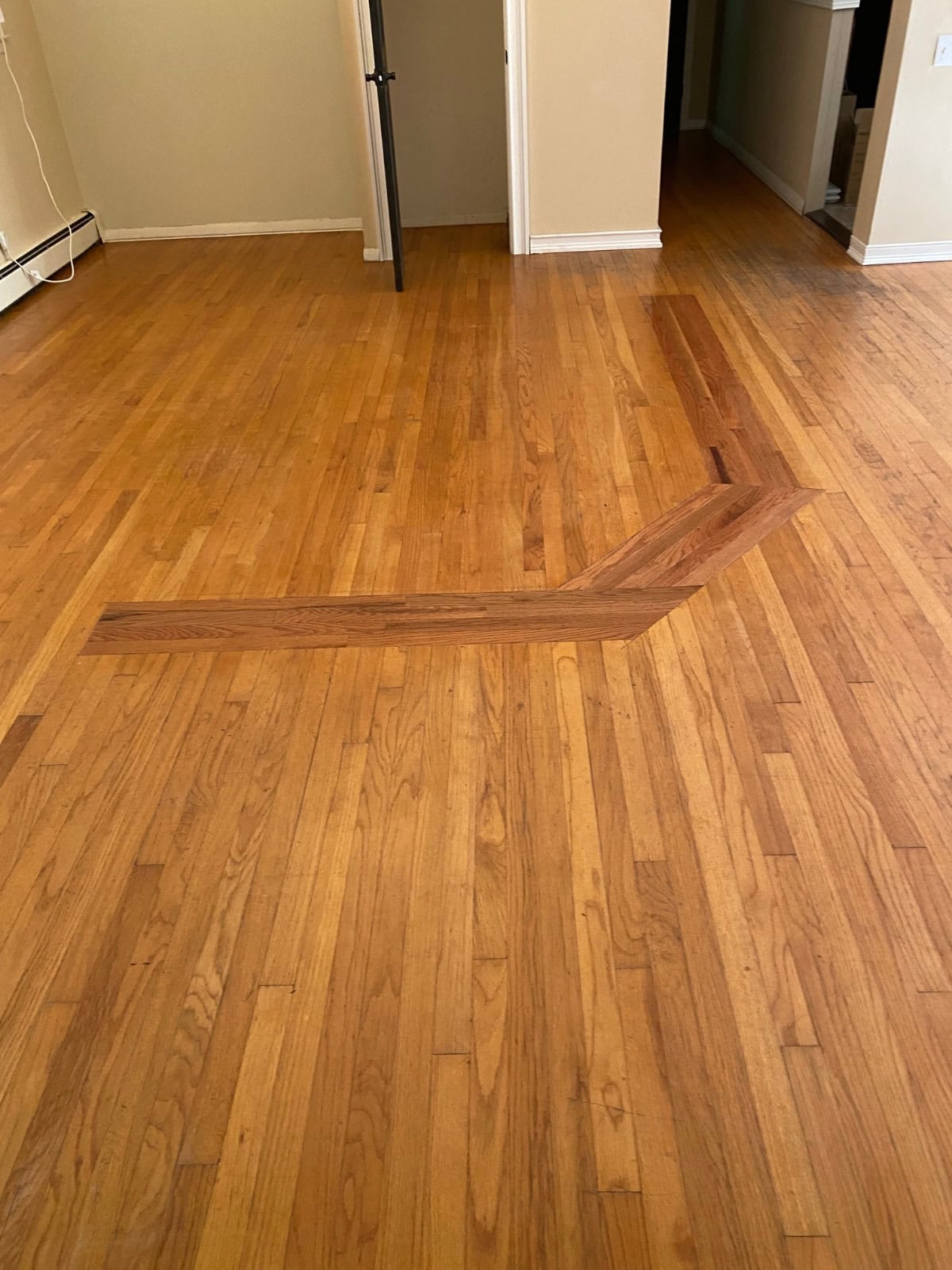
The homeowner had removed a wall as part of a larger renovation and was preparing for a new kitchen. Once the wall came out, it left an obvious break in the existing hardwood flooring.
Normally, our preferred method would be to tooth and weave new hardwood into the existing floor. That allows individual boards to be integrated into the old flooring so the repair blends as naturally as possible.
But that wasn't within the homeowner's budget for this particular project.
So we needed another solution.
It wasn't the way we would normally choose to make the repair, but we were able to create a clean hardwood transition that worked with the homeowner's budget and would make sense once the new kitchen was installed.
When Tooth-and-Weave Isn't in the Budget
There are different ways to approach hardwood floor repairs.
When a wall is removed and the existing flooring continues on both sides, tooth-and-weave repair is generally the method we prefer.
Instead of installing one straight piece across the opening, selected existing boards are removed at different lengths. New flooring can then be woven into the old floor.
When done correctly, that helps break up the repair and makes the former location of the wall much less noticeable.
But it's also more labor-intensive.
On this Storrs/Mansfield project, the homeowner was working within a budget and still had the expense of installing a new kitchen ahead of them.
So we came up with a more economical alternative.
Not every repair has to be the most expensive solution to be a good solution.
Turning the Old Wall Location Into a Transition
Rather than pretending the former wall location didn't exist, we used it to create a defined transition in the hardwood.
That's an important distinction.
If you're not going to weave the flooring together, the repair needs to look intentional.
A poorly planned strip of flooring can look like exactly what it is—a patch covering the place where a wall used to stand.
A properly positioned transition can become part of the room.
In this case, it also made sense because the homeowner was preparing to install a new kitchen. Once the rest of the renovation is complete, the transition will work naturally with the newly defined spaces.
Would we have tooth-and-woven the hardwood if budget weren't a consideration?
Yes.
But part of professional hardwood flooring work is also listening to the homeowner and understanding the entire project.
Sometimes the best solution isn't the most elaborate repair. It's the repair that works for the house, the renovation and the homeowner's budget.
UConn and Storrs
University of Connecticut is inseparable from the modern identity of Storrs and Mansfield.
The university traces its beginnings to 1881, when brothers Charles and Augustus Storrs donated land and money to establish the Storrs Agricultural School. That small agricultural school eventually became the University of Connecticut.
Today, the UConn campus, Route 195 and Downtown Storrs form one of the most recognizable parts of Mansfield.
Other familiar places include Horsebarn Hill, Ballard Institute and Museum of Puppetry, Mansfield Hollow State Park and Schoolhouse Brook Park.
Beyond UConn, Mansfield retains a very different character in places such as Mansfield Center, Spring Hill, Eagleville and Gurleyville, with historic homes, rural roads, farmland, forests and open space. The town itself describes Mansfield as a combination of historic villages, a vibrant downtown, scenic roads and preserved natural areas.
That mixture also means we encounter a tremendous variety of hardwood floors when working in the area.
Four Generations of Hardwood Flooring Experience
At Patrick Daigle Hardwood Flooring, Inc., hardwood flooring is our specialty.
Our family's hardwood flooring tradition dates to 1927, and our Connecticut business began around 1972. Today, we're the fourth generation carrying on that craftsmanship.
We're proud members of the National Wood Flooring Association (NWFA) and proud to be ranked #1 in Hartford County and #1 in Connecticut by BusinessRate.
Our work takes us throughout Storrs 06268 and 06269, Mansfield Center 06250, and surrounding communities including Coventry, Willington, Ashford, Tolland, Columbia, Lebanon and Windham.
This particular project is a good reminder that hardwood flooring work isn't always about creating a perfect invisible repair at any cost.
We explained the options.
The homeowner had a budget.
They were also putting money into a new kitchen.
So rather than performing the more involved tooth-and-weave repair we would normally recommend, we created a clean transition where the old wall had been removed.
And when that new kitchen goes in, the transition should make even more sense.
The wall is gone. The rooms are changing. And the hardwood floor is ready for the next part of the renovation.
Patrick Daigle Hardwood Flooring, Inc.
Fourth-Generation Hardwood Flooring Craftsmanship Since 1927
NWFA Member
Ranked #1 in Hartford County and #1 in Connecticut by BusinessRate
Serving Storrs 06268 & 06269, Mansfield Center 06250, Coventry, Willington, Ashford, Tolland, Columbia, Lebanon, Windham and surrounding Eastern Connecticut communities.