
Upcoming Hardwood Floor Refinishing in Willimantic, CT: Restoring an Elaborate Early-1900s Kitchen Floor
Every once in a while, we walk into a house and immediately know the floor is going to make an interesting project.
This upcoming hardwood floor refinishing project in Willimantic, Connecticut 06226 is definitely one of them.
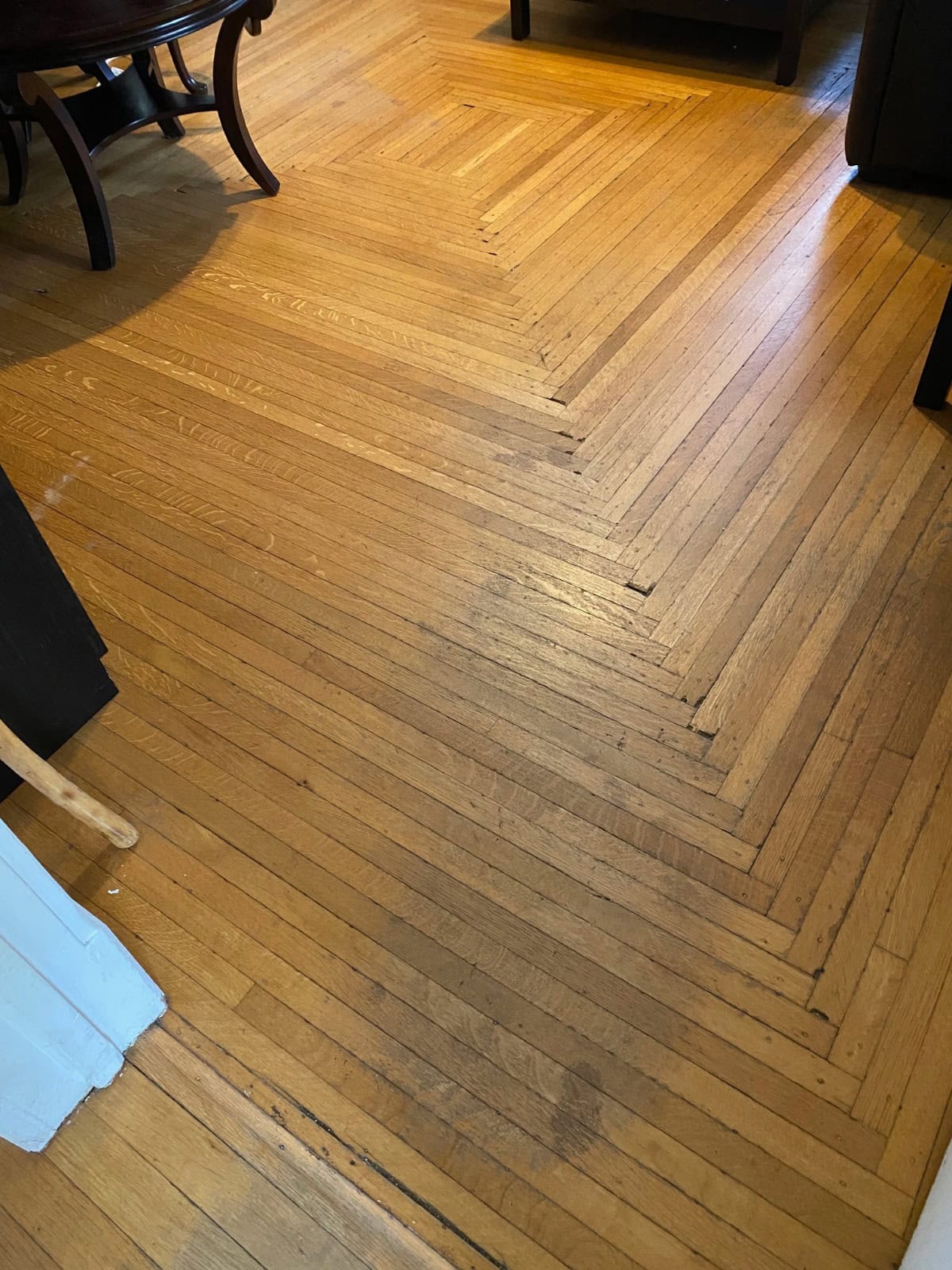
We'll be working in an early-1900s home with an elaborate hardwood layout in the kitchen. Instead of a conventional straight-laid floor, this one has a decorative log-cabin-style border pattern that works its way from the perimeter toward the middle of the room.
It's the kind of floor you don't see installed very often anymore.
And in the next few weeks, we're going to have the opportunity to bring it back.
An Elaborate Hardwood Layout Worth Preserving
What immediately caught our attention was the design of the floor.
The hardwood doesn't simply run from one end of the kitchen to the other. The boards form a series of borders that progressively work their way toward the center.
That creates an almost framed appearance.
A floor like this requires a little more thought when sanding because you're dealing with boards running in different directions rather than one continuous grain direction across the entire room.
The objective isn't simply to remove the old finish.
We want to properly sand the floor while respecting the original pattern and preserving the character that has survived in this early-1900s home.
The pattern is part of the floor's history. We want to uncover it—not sand the character out of it.
Why This Floor Should Look Completely Different With Water-Based Finish
Our plan is to finish this project with a water-based finishing system.
That's going to be an important part of the transformation.
Older oil-based finishes can develop a strong amber, golden or orange appearance as they age. In an older kitchen with an elaborate pattern like this, that darker coloration can sometimes make the individual boards and design harder to appreciate.
A waterborne direction should allow us to keep the hardwood looking lighter, cleaner and more natural, without adding the same degree of amber color associated with a traditional oil-based finish.
Once the old finish is removed and we get down to the raw wood, we're expecting the entire kitchen to brighten considerably.
And that should make the log-cabin-style layout much easier to see.
Sometimes lightening a floor doesn't hide its age. It actually makes the old craftsmanship easier to appreciate.
A Project We'll Be Following
Because this project hasn't been completed yet, we're not going to pretend we know exactly what the final floor will look like.
Real hardwood can surprise you.
Once we begin sanding, we'll get a much better look at the condition of the wood, the original construction and how the different sections of the pattern respond.
That's part of what makes this project exciting.
We'll be able to document the transformation from an older, darker floor to raw wood and then through the water-based finishing process.
When it's finished, we'll update the project photographs so homeowners can see the difference.
Right now, we're looking at the history. In a few weeks, we'll get to see what's hiding underneath it.
Hardwood Floor Refinishing in Willimantic, Connecticut 06226
Willimantic is part of the Town of Windham and has one of the most interesting industrial histories in eastern Connecticut.
The Willimantic River helped turn the community into an important manufacturing center during the 1800s. By the late nineteenth and early twentieth centuries, Willimantic was particularly well known for cotton and silk thread production, earning its familiar identity as Thread City.
That history makes an early-1900s hardwood floor especially fitting here.
Willimantic contains numerous older buildings and homes dating from the period when its mills and manufacturing economy were thriving. The town's planning history specifically notes the Victorian Hill area's mansions and many of the significant buildings constructed during Willimantic's industrial peak.
And You Can't Talk About Willimantic Without the Frog Bridge
One of the most recognizable sights in Willimantic is the Frog Bridge.
Officially known as the Thread City Crossing, the bridge celebrates two pieces of Willimantic identity at once: its famous frog story and its thread-manufacturing heritage. The enormous frogs sit atop giant thread spools, making the bridge unmistakably Willimantic.
It's one of those Connecticut landmarks that almost everyone remembers after seeing it once.
Other familiar local destinations include the Windham Textile & History Museum (the Mill Museum), the Connecticut Eastern Railroad Museum, Jillson Square and the Main Street Historic District.
Together, the mills, river, railroad history and older neighborhoods help explain why Willimantic contains so many interesting older properties.
Willimantic, Windham and the Surrounding Towns
Willimantic's primary ZIP code is 06226, and the surrounding Windham area includes Windham Center, North Windham and South Windham.
Our hardwood flooring work also takes us into nearby Mansfield and Storrs, Coventry, Columbia, Lebanon, Scotland, Chaplin, Hampton and Ashford.
That's one of the things we enjoy about working in this part of Connecticut.
You can move from an early-1900s Willimantic home to a rural farmhouse, a newer home near Mansfield and UConn, or another historic property only a few towns away—and find completely different hardwood floors in each one.
Four Generations of Hardwood Flooring Experience
At Patrick Daigle Hardwood Flooring, Inc., hardwood flooring is our specialty.
Our family's hardwood flooring tradition dates to 1927, and our Connecticut business began around 1972. Today, we're the fourth generation carrying on that craftsmanship.
We're proud members of the National Wood Flooring Association (NWFA) and proud to be ranked #1 in Hartford County and #1 in Connecticut by BusinessRate.
Projects like this upcoming Willimantic floor are exactly the kind we enjoy.
We're not walking into a house with an ordinary strip-oak kitchen floor.
We're looking at an early-1900s hardwood floor with an elaborate border pattern working all the way toward the center of the kitchen.
Our job will be to carefully sand it, uncover the original hardwood and use a water-based finishing system to give the room a brighter, cleaner appearance while preserving the unusual design.
And because this project is still ahead of us, there's something we don't normally get to say:
Stay tuned for the finished floor.
We're looking forward to seeing this one ourselves.